
Introduction
When you want to personalise textiles, whether T-shirts, hoodies or tote bags, choosing the right printing technique is crucial to get an optimal result. Each printing method has its advantages and disadvantages, and the choice of the right technique can depend on several factors, such as the type of fabric, the design, the quantity and the budget. At Printtex, we use the most advanced printing techniques to guarantee superior quality on every project. In this article, we will present the best textile printing techniques to help you choose the one that best meets your needs.
Contents
- Direct-to-garment printing (DTG): precision and versatility
- Screen printing: durability and quality in large quantities
- Transfer printing (DTF): flexibility and fine detail
- Embroidery: elegance and resilience for premium finishes
- Which technique to choose for your project?
1. Direct-to-garment printing (DTG): precision and versatility
Direct-to-garment printing, or DTG (Direct to Garment), is one of the most popular techniques for projects requiring great precision and faithful colour reproduction.
-
Advantages:
- Print quality: DTG can print complex designs with lots of detail and colour gradients directly onto the fabric. It is ideal for short runs or projects requiring a high level of personalisation.
- Versatility: This technique works well on a variety of fabrics, including cotton, linen and blends. It is particularly effective for personalised T-shirts and sweatshirts.
- Water-based inks: DTG generally uses water-based inks, which are particularly well suited to cotton.
-
Disadvantages:
- Cost per item: DTG can be more expensive than other methods for large runs, but it remains very competitive for small runs.
- Limits on some fabrics: This technique is less suited to dark or very thick fabrics, where pre-treatments may be needed.
2. Screen printing: durability and quality in large quantities
Screen printing is a traditional printing method that remains a preferred option for large quantities and simple designs.
-
Advantages:
- Durability: The inks used in screen printing are tough and stand up well to repeated washing, which guarantees a long life for the print.
- Cost-effectiveness: For large quantities, screen printing is often more cost-effective, because the cost per item falls with volume.
- Adaptability: This technique can be used on a wide range of fabrics and is particularly effective for single-colour prints or those with few colours.
-
Disadvantages:
- Complexity for complex designs: Designs with lots of detail or colour gradients are harder to reproduce with this method.
- Preparation time: The preparation process (making the screens) takes longer, which can extend lead times for small orders.
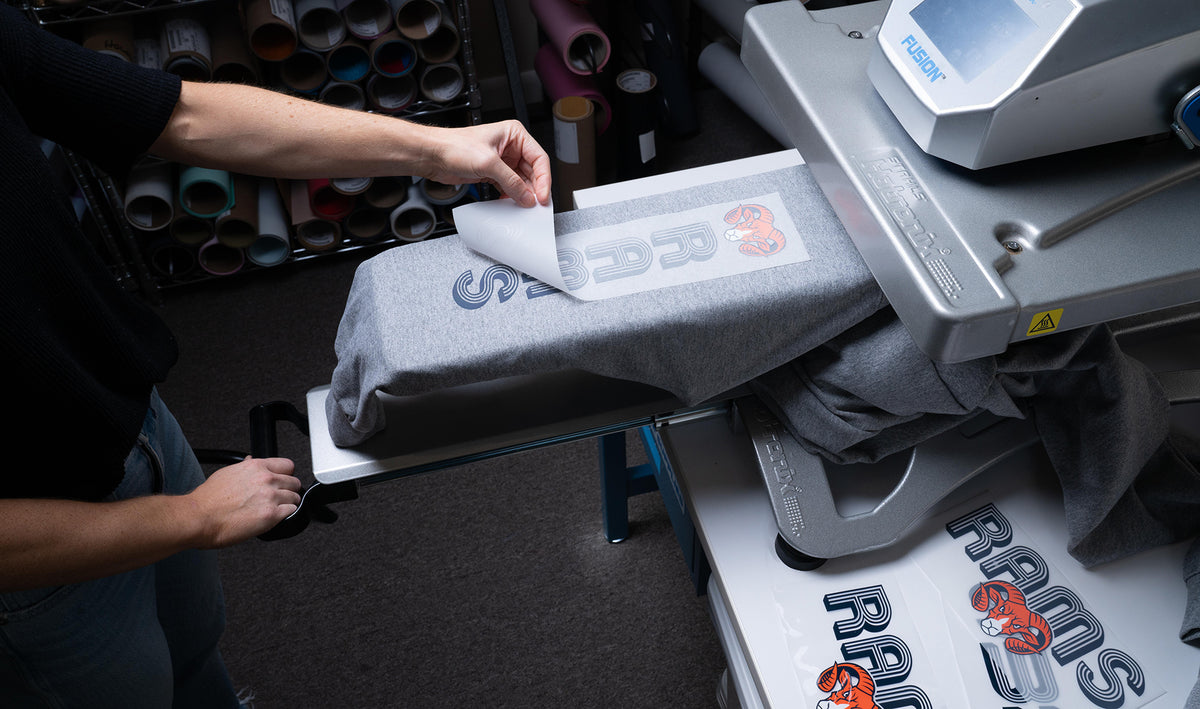
3. Transfer printing (DTF): flexibility and fine detail
Transfer printing, or DTF (Direct to Film), is an innovative method that is gaining popularity thanks to its flexibility and its ability to reproduce fine detail.
-
Advantages:
- Flexibility of materials: DTF can print on a wide variety of fabrics, including those that are hard to print on directly, such as polyester or very dark fabrics.
- Precise detail: This technique excels at reproducing complex designs with vivid colours and fine detail.
- Durability: DTF prints are very resistant to washing and wear, which makes them ideal for workwear or outdoor clothing.
-
Disadvantages:
- Texture of the print: A DTF print can sometimes feel stiffer to the touch, especially over large printed areas.
- Initial cost: Although competitive, DTF can be slightly more expensive than screen printing for very large-quantity projects.
4. Embroidery: elegance and resilience for premium finishes
Embroidery is the technique of choice for an elegant, professional look, particularly on thick fabrics such as polo shirts, hoodies or caps.
-
Advantages:
- Premium look: Embroidery gives a high-end finish, with a relief and texture that add value to the finished product.
- Durability: Embroidered motifs are extremely resistant and do not fade over time or after many washes.
- Adaptability: This technique works well on a wide variety of fabrics, particularly those that need a more professional appearance.
-
Disadvantages:
- Design limitations: Embroidery is better suited to simple logos or text and is less effective for very detailed or multicolour designs.
- Higher cost: Because of the complexity of the process, embroidery is often more expensive, especially for projects requiring a large area or a large number of stitches.
5. Which technique to choose for your project?
The choice of the best textile printing technique depends on several factors, including the nature of your project, the type of fabric and your budget.
- For complex, colourful designs: Go for DTG or DTF printing, which offer great precision and faithful colour reproduction.
- For large quantities with a simple design: Screen printing is ideal for bulk orders with simple designs and a limited number of colours.
-
For a premium, hard-wearing look: Embroidery is the best option for projects requiring an elegant, durable finish, particularly on corporate clothing or accessories such as caps.
-
Conclusion
Choosing the right fabric for a personalised print is an essential step to ensure a result that lives up to your expectations. At Printtex, we offer a wide range of premium-quality fabrics, including 100% organic options, to meet all your projects, whether for special events or ongoing production for businesses. To discover our full range of fabrics and get a personalised quote, visit our online catalogue or contact us via our contact page. Also see our FAQ for any further questions.
Take action: customise your garment online from 1 item, or request a quote for a bulk order.
Our pages by technique: DTF printing in Paris · textile screen printing in Paris · custom embroidery in Paris · textile flock printing (names and numbers).
Share:
How to choose the right textile for custom printing?
Why choose Printtex for your personalised textile printing?